How to Collect Memories From Family Living Abroad

When a family is spread across countries, memories end up spread out too. A cousin in Melbourne has the photos from the 1980s. An aunt in Toronto remembers the story about the wedding. A brother who couldn't fly home for the funeral has things he never got to say.
A memorial page can bring all of that into one place. But people rarely add memories unprompted — they need a gentle, specific invitation. Here's what works.
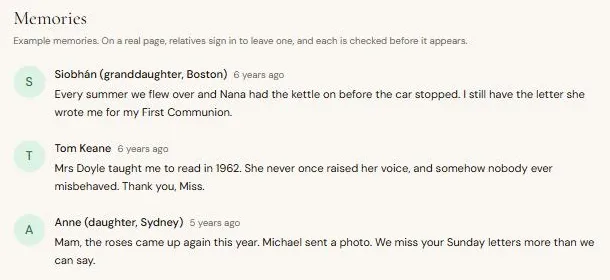
Memories on our example page. The people are fictional; the format is real.
1. Start with a page that's worth adding to
Before you ask anyone, put a little on the page yourself: a few lines of biography, one or two photos, the resting place on the map. People find it much easier to add to something than to start from nothing — and seeing the page helps them remember.
Memories and e-mail invitations work from the start; you don't need to verify the page first. Relatives don't need an account either: they write their name, how they knew the person and their memory.
2. Send a personal invitation, not a broadcast
A message to a family group chat ("Please add your memories!") is easy to scroll past. A short personal note works far better.
You can invite relatives by e-mail straight from the page, with a note of your own. Or send the link in whatever messenger the family already uses — it shows as a card with the name and photo.
Something like:
Hi Maria — I've made a page for Grandma so everyone has somewhere to remember her together. You knew her in Lisbon before any of us were born. Would you share a story or two from those years? Even a few lines would mean a lot.
The difference is the specific ask: you knew her then, so tell that.
3. Ask questions people can actually answer
"Share a memory" is surprisingly hard to respond to. Narrow questions are easier:
- What's the first thing you remember about her?
- What did she cook when you visited?
- What did he teach you without meaning to?
- Is there a photo of the two of you that you love?
- What would you tell him now if you could?
Different relatives will answer different questions. Send each person the one that fits them.
4. Mind the time zones and the languages
- Send invitations at a sensible hour for the person receiving them. A message that arrives at 3 a.m. is easily forgotten by morning.
- Let people write in their own language. A memory in Portuguese or Arabic is still a memory, and the family member who reads it will treasure it. Others can use their browser's translation.
- Older relatives may prefer to talk. Phone them, ask the questions, and post what they tell you — with their permission and their name.
5. Collect photos carefully
Relatives abroad often hold the only copies of certain photographs. Ask them to send a phone photo of a print if scanning is a hassle — it's usually good enough.
As the page's creator, you add photos to the page yourself, so they stay in one place and in the order you choose. Before posting a picture of living people, check they're happy for it to be shared.
6. Make it a habit, not a one-off
Memories come back slowly. Anniversaries, birthdays and holidays are natural moments to send the link again: "It's Dad's birthday on Sunday — if anything has come back to you this year, add it to his page."
What visitors can and can't do
- Anyone with the link can leave a memory, with or without an account. Everyone writes a name, so you always know who it's from.
- Every memory is checked automatically before it appears; anything unclear waits for a person on our team.
- You can delete any memory on your page, or turn memories off altogether — the ones already shared are kept and come back if you turn them on again.
Distance makes grief lonelier. A page where a granddaughter in Boston, a former pupil next door and a daughter in Sydney can all leave their words side by side makes it a little less so.